
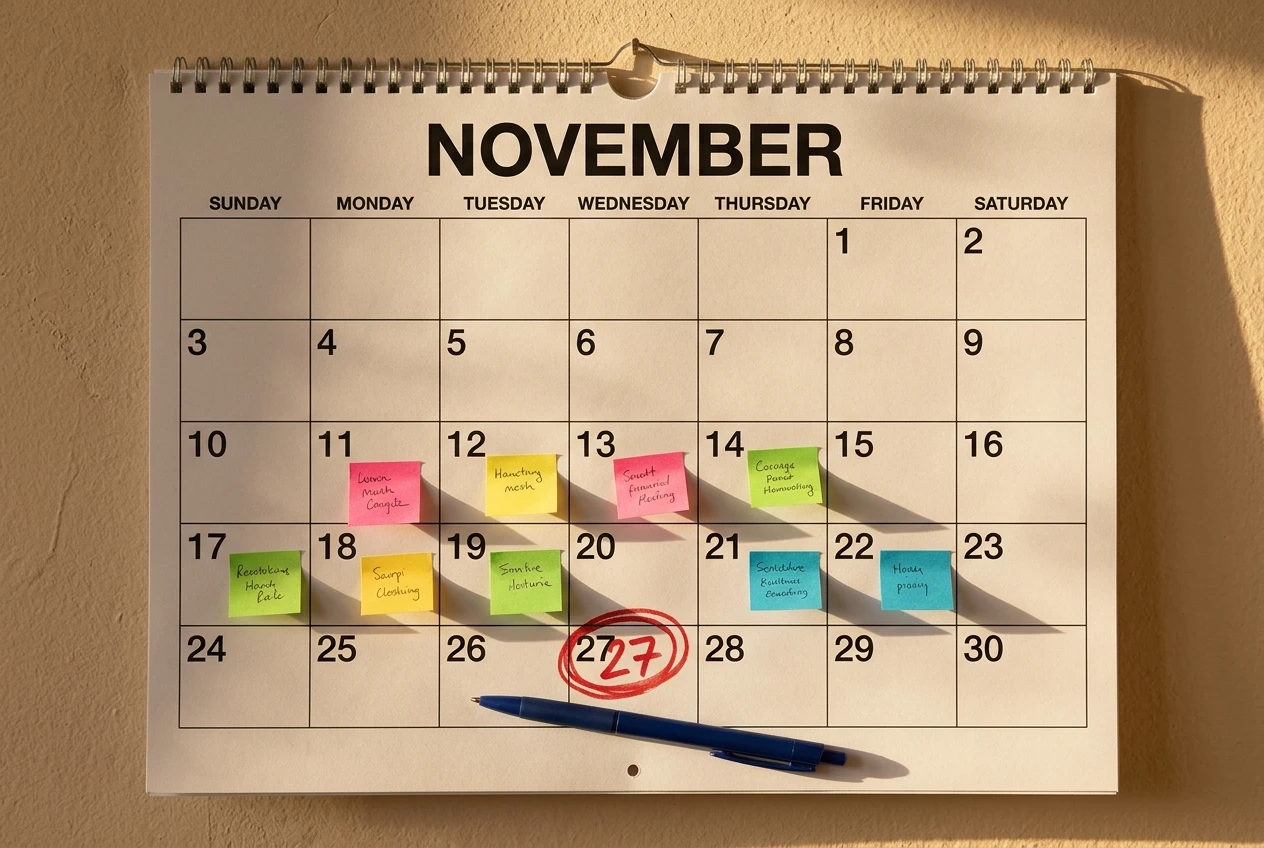
If you are working alone, the four weeks before November 27 go fast. This black friday marketing checklist has 25 tasks, grouped by when they need to be done, so you can start at the top and work down. Today is Sunday, November 1, which leaves 26 days. Most of the heavy work belongs in the first two weeks, and the last week should be mostly scheduling and checking.
Pick the items that fit your business. A blogger with an email list and an affiliate account needs most of them. Someone selling one digital product can skip the affiliate section.
Lock in your offer, your goal and your numbers first (items 1 to 5)
Everything else in the checklist depends on these five decisions. If you make them this week, the pages, emails and posts that follow can be written once instead of rewritten.
1. Choose one main offer. Pick one product, bundle or promotion to put in front of people. A sale with five equal options makes visitors compare instead of buy, and it gives you five things to track and explain. You can mention other items, but one of them should clearly be the headline.
2. Set one goal as a number. Decide whether you are measuring sales, revenue, email signups or affiliate commissions, then put a figure on it. Work backwards: if you want a certain number of sales and expect only a small share of visitors to buy, you can estimate how many visitors or subscribers you need. Use your own past conversion rates if you have them, and treat the result as a rough target.

3. Calculate the lowest price you can afford. Subtract payment processing fees, platform fees, affiliate payouts and any costs per sale from the discounted price. If a 40 percent discount leaves you with nothing, it is the wrong discount. Write down your floor before you design the offer, so you are not deciding under pressure on the day.
4. Fix the start time, end time and time zone. State dates and hours in the same time zone everywhere, and say which one. A vague “ends soon” gives no reason to act today, and a deadline you extend repeatedly teaches your audience to ignore the next one. Decide now whether the sale ends on Black Friday, runs through Cyber Monday on November 30, or covers the whole weekend.
5. Write the offer in one sentence. For example: who it is for, what they get, what it costs, and when it ends. Every email, post and page will be built from this sentence. If you cannot write it in one go, the offer is not settled yet.
Get your landing page, links and tracking working before traffic arrives (items 6 to 10)
Aim to have this section finished by about Sunday, November 8. Broken links and untracked sales cost the most on the busiest days, and they are easy to prevent with a few hours of checking now.
6. Build one dedicated page for the offer. Send all sale traffic to a single page that explains the offer, shows the price and deadline, and has one clear action. Sending people to your homepage makes them hunt for the deal. If you need a refresher on layout, headline and form design, the guide on how to build a landing page that converts visitors into signups covers the structure in detail.
7. Click every link on a phone. Most email and social traffic is opened on a mobile device, so test there. Check buttons, coupon codes, checkout links and any link that opens an app. Fix anything that redirects to the wrong place or drops a discount code.

8. Set up tracking for each channel. Add a separate UTM tag to the links you use in your email, each social platform and your blog, so your analytics shows where each visit came from. Then confirm that your analytics tool or affiliate dashboard actually records a conversion. Without this you will finish the weekend knowing the total but not which channel produced it.
9. Run a test from start to finish. Sign up with a test email address, or complete a purchase with a real small payment or your payment provider’s test mode if it has one. Check that the confirmation email arrives, that the download or access link works, and that the thank-you page loads. Look at what a buyer actually sees, not just what your dashboard says happened.
10. Prepare for volume and for the end of the sale. Compress large images, remove scripts you do not need and check with your host whether a traffic spike could cause problems. Also build the “sale ended” version of your page now: a short message with a waitlist signup or a link to your regular offer. Swapping it in takes a minute when the page already exists.
Warm up your list and your audience in the next two weeks (items 11 to 15)
People rarely buy from someone they heard from for the first time on Black Friday. The two weeks from about November 9 to November 22 are for reminding your audience that you exist and giving them a reason to look out for your offer.
11. Send a heads-up email to your list. Tell subscribers what is coming, roughly when, and who it is for. Do not reveal every detail; give enough that they can decide whether to watch for it. If you have not emailed for a while, send something useful first so the sale announcement is not the first message in months.
12. Create an early-access or waitlist option. A simple signup form on your landing page lets interested people raise their hand before the sale opens. Those who join are your warmest audience, and you can email them first on the day. Even a small waitlist gives you a real number to compare against your goal.
13. Post consistently on the platforms where you already have an audience. Share useful content on a regular schedule before you mention the sale at all. If you are still earning attention on social media, the article on how to build trust on social media when nobody knows who you are yet explains how to do that without sounding like an advert.
14. Collect the questions people ask. Read your comments, replies and emails and note the doubts that come up repeatedly: price, whether it suits a beginner, how long it takes, what happens if it does not work. Each one becomes a line on your landing page, a social post or an email. Answering objections in advance usually helps more than adding urgency.
15. Gather proof from real customers or readers. If people have already bought, used or reviewed what you offer, ask whether you may quote them. Use their actual words and get permission before publishing names or photos. If you are new and have no customers yet, leave this item out. Use clear explanations and specific details about the offer instead of inventing endorsements.
Publish and update the content people will actually search for (items 16 to 19)
Shoppers search for specific things in November: products by category, comparisons and “is it worth it” questions. Content you publish or update in the second and third weeks has time to be indexed before the sale. Aim to finish this section by about Sunday, November 22.
16. Update your existing posts first. Pages that already receive traffic are the quickest wins. Add the sale details, a link to your landing page, and a note of when the deal ends, and remove any outdated prices or claims. Older posts on your site rank on trust built over time, which is the idea behind the guide to SEO for bloggers and rankings that last past the next algorithm update.
17. Publish one post that matches a shopper’s question. Write about a specific need, such as who the product suits, what is included, or how to choose between options. Use the wording your audience uses, which you collected in item 14. A clear, honest page that answers one question well is more useful than a long list of deals with no context.
18. Write a comparison or alternatives post. People deciding whether to buy often look for how options differ. Compare features, price, and who each one suits, and say plainly when something is a poor fit for a particular reader. That honesty helps readers decide, and it makes your recommendations easier to trust.
19. Link your content together. Add internal links from relevant posts to your landing page and to each other, and check that every link points to a live page. If you want a framework for deciding which pieces are worth the effort, content marketing fundamentals covers how to judge whether each page earns its place. Remove or redirect pages for expired offers so visitors do not land on deals that no longer exist.
If you promote other people’s products: check terms, deals and disclosures now (items 20 to 22)
Skip this section if you only sell your own products. For affiliates, the risks in this section are easy to prevent and costly when ignored: a commission that does not track, a deal that does not exist, or a promotion that breaks a program’s rules.
20. Read each program’s current terms. Look for rules on coupon codes, paid advertising, use of brand names, email promotion and how long a referral cookie lasts. Terms can differ between programs and can change, so check the current version rather than relying on what you remember. If a rule is unclear, ask the program’s affiliate manager or support team in writing.
21. Confirm every deal with the merchant before you publish it. Check the price, the discount, the dates and any conditions on the merchant’s own page or in their affiliate communication. Never announce a discount you have not verified, and never guess the end date. If the merchant has not yet announced Black Friday pricing, write content that will remain accurate and add the details once they are confirmed.
22. Put disclosures where readers will see them. Tell readers clearly, close to the link and before they click, that you may earn a commission. Do this on your site, in emails and in social posts. Rules vary by country, so check the guidance that applies where you and your audience are, such as the FTC’s endorsement guidelines in the United States. For a longer view of how to build commissions that last beyond a single sale weekend, see how to build affiliate income that still pays when the trends move on.
Schedule launch week so you are not building while the sale is live (items 23 to 24)
By Monday, November 23, nothing new should be under construction. The week of the sale is for sending, watching and responding, not for writing.

23. Schedule every email and post in advance. Write the full sequence and load it into your email tool and scheduler with exact send times. A simple sequence might include a “sale is live” message, a mid-sale reminder and a last-chance message on the final day. Read each scheduled message once more to check the links, the dates and the price. A common mistake is a reminder that still says “starts tomorrow” after the sale is already running.
24. Plan how you will watch and respond. Choose set times to check your orders, tracking and inbox, perhaps once in the morning and once in the evening, instead of refreshing all day. Keep a short list of what to verify: the landing page loads, the checkout works, the discount code applies and emails are going out. Prepare short replies for the questions you expect, such as refunds, access problems and deadlines, so you can answer quickly without writing from scratch.
What to do the Monday after Black Friday (item 25)
25. Follow up, record the results and clean up. If your sale ends on Black Friday, Monday is November 30, which is also Cyber Monday, so decide in advance whether you will extend the offer or close it. Whichever you choose, set aside time that day for these tasks:
- Export your sales, signups or commissions and compare them with the goal from item 2.
- Check your UTM-tagged links to see which channels produced results.
- Thank buyers and make sure they can access what they purchased.
- Send a short email to people who clicked but did not buy, restating the deadline if the offer is still open.
- Swap in the “sale ended” page and remove expired prices and codes from your posts.
- Write a few notes on what worked, what broke and what you would change, while you still remember.
Those notes are the most useful result of the whole exercise. Next year’s checklist starts from them rather than from a blank page.
If your foundations are not ready yet
If you read this list and realised you do not yet have an email list, a working site or a clear idea of who your audience is, you can still use the next 26 days to build those basics. Then the 2027 version of this checklist will be much easier. The Digital Marketing Free Starter Course is a good place to start laying those foundations so you are ready for next year’s sales season.